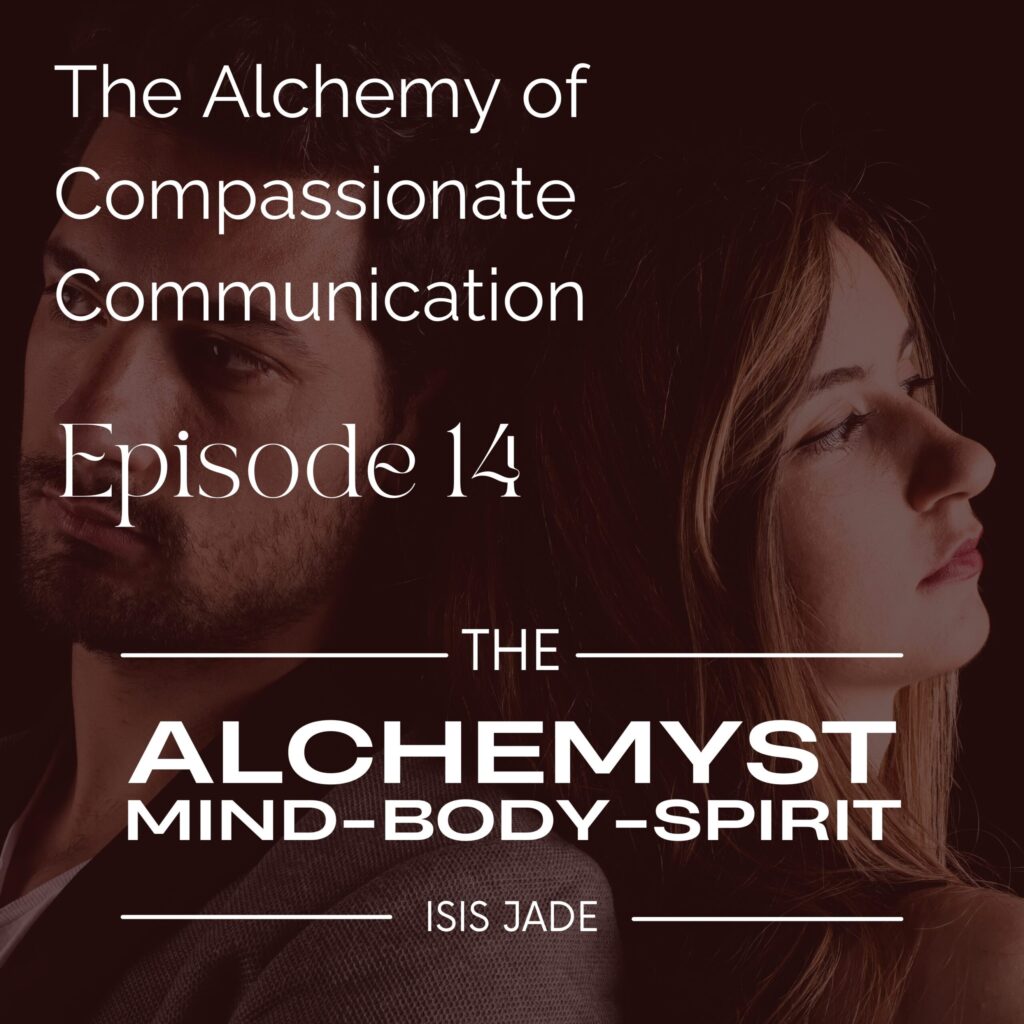
In this episode we talk about the alchemy of nonviolent communication and how it can transform your relationships and how you can use this alchemy to get your needs met in a manner of self-sufficiency. This is compassionate communication as alchemy.
We discuss why the concept of the “HELP” paradigm in the self-help, coaching and healing industries is a particularly toxic infrastructure and how to communicate without falling into the trap of enslavement and power struggles.
I go into the 3 levels of listening, how to compassionately listen to meet your own needs as well as the needs of those you are in a relationship with, and what it actually means to communicate interdependently rather than codependently.
The Alchemy of Compassionate Communication is especially powerful when you begin to incorporate some of these very basic strategies into your life.
In This Episode
This episode is about the alchemy of compassionate communication, also known as nonviolent communication, and how it transforms your relationships. You discover how to get your needs met from a place of self-sufficiency and sovereignty.
I talk about why the rescue paradigm running through so much of the self-improvement and healing world creates a toxic structure, and how to communicate free of enslavement dynamics and power struggles.
I also share the three levels of listening, how to listen with compassion to meet your own needs and the needs of the people you love, and what it means to communicate interdependently. Small, basic shifts in how you speak and listen carry enormous power.
This teaching transforms marriages, friendships, families and teams, and it begins with the way you listen to yourself.
Key Teachings
Compassionate Communication Begins in Your Heart
Every word you speak carries the resonance of the heart it comes from. When your heart is open, your words land as an offering. When your heart is guarded, even kind words arrive as armor.
Your heart is 10,000 times more powerful than your mind. I call this heartset. When you speak from heartset, the people around you feel safe enough to open too. This is the Law of Delight at the dinner table, in the boardroom and in the bedroom conversation that matters most.
Before you speak, ask yourself one question: What is the most loving truth I can offer here? That question alone changes the whole tone of a conversation.
Sovereign Needs, Shared Freely
You are the first one responsible for meeting your needs. This is a freeing truth. It means your happiness lives in your own hands, and the people you love become partners in delight.
When you know your needs and name them clearly, you ask from fullness. You offer from fullness. Requests become invitations, and the other person is free to say yes with a whole heart.
The rescue paradigm teaches you that someone outside of you fixes you, saves you or holds the answers. Sovereign communication returns the answers to you. You stay whole, and the other person stays whole too.
What do you need today that you have been waiting for someone else to give you?
Listening as an Act of Love
Listening is the most generous gift you give another soul. When you listen with your full heart, you hear the feeling beneath the words and the need beneath the feeling.
Turn that same listening inward. What is your own heart asking for right now? The more clearly you hear yourself, the more clearly you hear everyone else.
Compassionate listening asks for presence. Put down the phone. Let the silence breathe. Resist the urge to fix, and simply let the other person feel heard. Feeling heard is one of the deepest forms of love a soul can know.
Interdependence Is the Language of Equals
Interdependent communication honors two whole, sovereign people meeting in the middle. Each of you stands in your own power. Each of you chooses to share.
Codependent patterns grow from the belief that someone else holds the key to your worth. Interdependence returns that key to you. From there, love flows both ways with ease, and delight shared becomes delight squared.
When both people speak from their own sovereignty, power struggles lose their fuel. There is nothing to win. There is only a shared desire for the highest and best outcome for everyone involved.
A Practice to Take With You
Before your next important conversation, pause for one minute and ask your heart three questions. What am I feeling? What do I need? What simple request honors that need?
Then, during the conversation, listen for the same three things in the other person. Reflect back what you hear: “It sounds like you feel this, and you need that.” Let them correct you if you missed it.
Close by naming your own request in one clear sentence, with warmth and with no strings attached. Notice how the whole conversation softens and opens.
Watch the Episode
Watch the full conversation on compassionate communication here.
Keep Exploring
Compassionate communication grows naturally from the Law of Reflection, which shows you what your relationships mirror back to you, and from the sacred flow of giving that keeps love moving both ways. If old wounds shape how you speak, explore how to heal from betrayal and come home to yourself, and read about heart-centered relationships born of delight. To step fully out of power struggles, discover spiritual sovereignty.
Have you done the free assessment? Start now.
Go Deeper

Bioenergized healing tool
Vishuddha Throat Chakra Alchemy
Support your throat center as you speak your needs clearly.
$40

Bioenergized healing tool
Open your heart before an important conversation.
$42
Private session with Isis
Private time with Dr. Isis Jade to realign the way you communicate in your relationships.
$333
Frequently Asked Questions
Why does communication feel so hard?
Most communication is unconscious, automatic and reactive. We often speak before we think and wish we could take it back.
What is Nonviolent Communication?
A practice of honest, compassionate expression and empathic listening. Dr. Isis Jade met women from the Santa Cruz Nonviolent Communication community at a retreat.
How do I express my needs without conflict?
Name your feelings and needs from your own heart, without blame, and make clear requests that others are free to meet.
Does meeting everyone’s needs mean compromise?
Dr. Isis Jade teaches that giving and receiving openly and with affection meets the needs of everyone involved, as equals.
What does it mean to listen as an act of love?
It means listening to understand the feelings and needs beneath the words, without rushing to respond or defend.
Full Episode Transcript
Transcript of this episode of Manifest with the Law of Delight with Dr. Isis Jade. Lightly edited for clarity.
Read the full transcript
Hello and welcome to the Alchemyst with Isis Jade, the keys to living your very best life in alignment with your mind, body and spirit. My name is Isis Jade and I am delighted that you are here. This podcast is full of immediate strategies that you can apply today to bring
yourself back into full alignment and live your very best life fully in body and mind, body and spirit through a variety of holistic tools including energy healing, aromatherapy, herbs, secret universal laws, visualization tips, how to break any bad habit fast and how to completely reframe your entire self-concept and more. So if you are ready for your total mind, body and spirit level up and brilliant soul, you’re in the right place. How do we come into a place of power? How do we come into a place of self-empowerment? How do we experience empowerment even when things in our life are going awry? Communication to me is a big deal. It’s one of those things I feel that most of us
sort of struggle with. We don’t really spend as much time considering and contemplating our methods of communication both interpersonally and with our intimate relationships as well as externally and within ourselves as well. Most people’s communication styles are very, I would say, unconscious and tremendously automatic and reactive. We don’t always think about what we’re going to say or what comes out of our mouth until it’s already been said and we wish as we cover our mouths, wish we could take it back. I’m a very passionate person and I’m very, very much a feeling person and very empathic person as well as an emphatic person. So coming back from going to this retreat, I really didn’t know what to expect.
I met some amazing women from the Santa Cruz Nonviolent Communication organization and they’re also providing a number of really great workshops through their organization there in Santa Cruz. So to be able to meet these amazing women and listen to their stories and share with them a little bit about what I was going through both personally and professionally and as I’m rebuilding my life after separating from my husband, it’s been a very painful experience. I really felt the need that I would like to reconnect with myself on a deeper level but also learn better ways to communicate and I felt that this is some place that I really struggle with because I don’t always feel that the words that I have and the language I have
is conveying my deeper sentiments or my deeper feelings and so much of those of us who struggle with post-traumatic stress disorder or generalized anxiety disorder or have social phobias, we’re not always able to grasp a firm handle of language in order to get our needs met or to have an understanding of how to interact and relate to people around us. So dealing with post-traumatic stress as well as the brain damage I suffered and rebuilding especially my language patterns because that was one of the things that was really a struggle for me early on. Language has always kind of been a barrier for me. I can write prolifically but when it comes to speaking from my heart or speaking words of wisdom to another, sometimes I’d feel at a loss for the
words that would be most empowering to this in the other individual and I recall an interaction that was very humiliating for me early on in life. I was at a seminar at an expo and I was offering services at this booth that I was working at and I met with a person who seemed really, really charming and tremendously, tremendously in need of assistance and she was telling me about some of the issues she was struggling with, anxiety similar to mine, stress levels similar to mine, fibromyalgia. She had all of these terms that she was using to describe a lot of the issues she was dealing with and they were all in line one at a time, one at a time that she was labeling was
exactly what I had been going through my whole life. So when I told her about my story she was very intrigued by it and we sat down and she says, oh I’m in so much pain today, you know, my shoulders and my back, I’m just in a lot of pain. It’s just chronic now and that’s how I’ve been for the last 20 years and I could relate. I really can relate. Most times my pain level, I would say is at a four or five which for me is pretty tolerable. I can handle that, that’s my life but when it starts to eek up into the six and seven range that’s where I just can’t function as well and when it goes up to eight, nine, I’m crashing.
So I sat her down and I said, here let me help you with that and release this pain and she jumped up out of the chair and she flipped around and she said, nobody helps me with anything darling, I don’t need anyone’s help and you need to learn to use better communication and better words before you start to offer assistance or provide guidance or advice to anyone and with that she stormed off, she was very, very angry and she came back later and actually complained to another one in my gals who was working with me at the booth who was really just as shocked as I was. It wasn’t until I did some inner thought process and work around this and this came up for me
again several years later that the word help for some people becomes a disempowering term. It means that you’re not capable of doing this for yourself so I should intervene and do it for you and a lot of people have problems with the definition of help. This is something that I Actually talk about extensively both in my upcoming book as well as some of the courses that I’ll be providing for women enable you to step into a more self-empowered position to be able to offer services and truly live your life purpose. One of the things that I learned out of that event was that many, many people what they’re not looking for is help. When we sit down and ask
ourselves do we ask for help? Not too often we’re actually looking for advice, guidance, or assistance but we don’t actually look for help. Very few people look for help. When we sit there and we talk about our life purpose and with many of my clients the very first thing that comes out of their mouth is oh I want to help people and that’s where I get my excitement, that’s where I get my passion is by helping people and that exactly those words were the words I used to use as well. That helping people would be the way to go. I really want to help people and live more rich and valuable and powerful lives. Help. You know the term help is one of those
terms that can be a landslide for many people. It can turn into a disempowering life draining experience for both the service provider as well as the client. Lots of ngos out there, non-government organizations, non-profit organizations, npos, they really specialize and focus on altruistic recommendations for helping people and volunteers. What do volunteers love to do? They love to help. So when a client comes to me and says well I want to structure my business around helping people, I tell her well then you’re not looking to build A business, what you’re actually looking to do is build a non-profit organization that provides those services for people. However, if you want to empower women or empower people or you want to
provide a service that enables people to do more with their life, then perhaps you’re looking to build a business. That really struck people, some women, very wrong because we’re always been defined socially as helpers. We’re supposed to be the helpers. That’s our role in our society today is to be the helper, the assistants, the go-to person. We run errands, we take care of kids, we’re the helpers and the secretaries and the office managers, we’re the organizational people, we’re the people that make sure everything’s on task, we’re the detail-oriented people, we’re the people that can track things and come to conclusions and help people do the work that they’re supposed to do. So the term help, and this is going to be kind of an interesting segue
back into Nonviolent Communication and compassionate communication, I find is a disempowering energy and most of the energy associated with the word help is both disempowering for the individual providing the work, the help, as well as for the person who is being helped or rescued for example. So coming back to this place, when we start talking about how we communicate both our services, ourselves, our higher nature, our true purpose, our stepping into our passion purpose, really working around language and defining parameters around language so as to empower people or to engage with people or enable people to do more with their own lives or to be able to make better decisions or more informed choices or better informed choices for their health or for their
wellness or to coach people, that’s another one that a lot of people like to use is to coach people, to making better choices for themselves and empowering them to find new avenues for self-expression or new avenues for more engaging and abundant work. When we’re talking about using that, these terms as opposed to terms related to help rescuing, we provide, we start to give people options as opposed to here let me help you. I could have said to this person, let me provide you with some options or allow me to show you some options and you know in releasing this pain. I have some experience in doing this and I’d love to share with you some of the options that
I’ve come up with that work for me. Now if I had given her options and choices then she would have felt empowered to continue that conversation with me and since she was really much a woman about dynamism and empowerment and self-core nature and that’s what she radiated out with throughout her whole body, if I had come up to her and talked to her in her language and a language that she could understand as she could relate to, then I think our relationship would have grown into something much deeper and fewer for found. Unfortunately I used a trigger word for her that sent her reeling where she felt that she would be in a dominant relationship where she
was going to be subservient to me in some way and that’s another aspect of the word help. The word help implies in some way that one person knows more than you or knows more about what’s better for you than you do for yourself. So the word help provides this dogmatic space for a subservient relationship, a relationship where one person is above another in some way rather than being on an equilateral experience, an exchange of energy and an exchange of ideas or an exchange of options and choices and having a discussion around those opportunities. Yeah, this is kind of getting into this really weird segue here. I do apologize but when we were talking about Nonviolent Communication, the ladies that I was meeting with at this retreat had really
talked about the fact that all our forms of communication and all actions are actually attempts to get our needs met or to meet our own needs and this is where we start looking at the word help in this paradigm especially and to talk about this idea that I need help getting my needs met. Well, not necessarily. If everything comes from within, right, and this is something we talk about, about goddess empowerment, stepping into your true goddess nature, coming back into your infinite nature, your infinite self, your higher self, all your needs are met from within so you don’t have to look outside of yourself to get those needs met and so then we don’t have this
draining paradigm and paradox where I have to raise my hand and say I need help and then as soon as you raise your hand and you need help you’re put into a system or a program or a giving resources available to you. You don’t necessarily need any of those things. You might just need ideas and strategies and support framework that would work for you rather than you being put into a system and you having to fit yourself to a system or a solution. You then can craft your own system and solution that best supports your needs being met from within. If every action and every interaction that we have is motivated by a desire to meet a need or several
needs then we all are interacting from that space that we need to meet our needs and at each moment we’re simply just doing the very best we can to meet our own needs. So when you’re interacting with another person be it an intimate partner or a family member or a friend and you’re kind of getting into a confrontational conversation where you’re starting to feel defensive or angry or there’s many other feelings that you’re having those feelings are symptoms. They’re kind of highlighting the fact that there’s something missing in this interaction. There’s something that’s triggering you to feel this way. So when we look down deeper into this core dynamic of this interaction we can go back to saying there must be a need that I’m seeking from this interaction
and I’m not getting it met and it’s not really up to her or him to meet that need for me. It’s actually I need to come back to center, to core and meet that need from within and accept what she’s saying works for her in her world view not necessarily in my world view. And now the next premises of Nonviolent Communication as well as this idea that we disempower ourselves by always seeking help or always looking to provide help is this idea that human needs are universal and we all have the same needs and we often use different strategies for meeting our needs and it’s at the level of strategies are different strategies not our needs that conflict and conflicting conversations and I would say inflammatory
conversations occur. So if we’re always looking outside of ourselves and expecting our needs to be met by someone else we actually instigate more conflict than we resolved especially if that person isn’t capable or it doesn’t desire to meet that need because honestly in the real scheme of things it’s not their job to. So by focusing on our own internal needs we can prevent, reduce, and even resolve a variety of conflicts. So when we’re looking at providing help and we’re going to go back to that word I use the word help to explain what happens when we use that energy associated with the word help. Help to me is an acronym. Help means that we’re going to be engaging
in some kind of a conflict in order to limit our perception or challenge our perception. So the acronym for help has become for me a harmful experience that limits our potential. H-E-L-P A harmful experience that limits our power a harmful experience that limits our possibilities. So when we raise our hands asking for help or we encourage people saying we want to help people or we think that our true life purpose is all about helping people we forget to understand that the dogmatic energy the systematic energy that’s really defining the word help. Where is that energy coming from? What’s that resonant energy coming from? Why do you feel the need to help people or why do you feel the need that you need help? When we start looking at the energy and
the resonance of various words and the definitions that they come with we’re able then to better understand how we interact with that word and how it makes us feel inside. So initially when we start to say that I want to help people and I raise my hands there’s an underlying need within that purpose that we feel we have to get met. Now when I ask people and their underlying purpose and they say I want to help people it’s going to last great. Well why do you want to help people? And usually we keep asking and ticking away at that word help until we find the true underlying need that person is seeking to get met that underlies everything that they’re doing their
inner motivation their driving force and once we crystallize that then that then becomes their purpose. It’s no longer about helping people but it’s about this it’s about meaningful work it’s about finding powerful interactions with people it’s about inspiring people it’s about motivational work it’s about giving people tools and strategies so that they’re able to manifest lives of their dreams things like that and we eliminate the negating energetic force of help and we negate and limit the number of harmful and conflicting experiences that might be limiting our potential limiting our power and limiting our possibilities. So if our needs are universal and all needs can be met from within do we really need to help each other? Well we live in an interdependent society
and I call this interdependent it’s not a dependent society a dependent society is a very unhealthy relationship between two people who are codependent upon each other and that creates a force of I’m dependent upon this person for my needs to be met and the other person is dependent on that person that get his needs met and this creates a constant twist and turn of a subservient master slave paradigm and paradox servant master however you want to say dominant submissive sort of interaction and it’s a constant battle between those two who’s submissive who’s the dominant who’s the controlling and who’s being controlled where is the power going where is the power shifting who’s in power in the relationship and it all becomes about controlling and dominating and
demanding and needy energy as opposed to functional joyful healthy interdependent energy. Now if I know I can get my needs met from within and he can get his needs met from within then we can work on a higher level of playing field and support each other’s goals and dreams and desires without feeling like in some way we’re lacking in that interaction. Now the next phase of the underlying premise of Nonviolent Communication and passionate communication this is what I really love all of this is about compassion it’s about empathy it’s about understanding the underlying conversation that’s going on under these words and understanding the deeper meanings behind people’s interactions and communications with one another so it’s all about going into any
conversation with a deeper intent of ensuring that you are setting yourself up for a position of empowerment and you’re not giving your power away to another person but that you’re also assisting them in looking within and finding that power within them or stop with the help paradigm and we become empathic compassionate and empowering paradigms completely different paradigm it takes you on a completely different level playing field instead of operating down low where you’re constantly rescuing constantly in need of help constantly looking for help you become a much higher functioning being where you’re constantly in an interdependent relationship where you’re supporting people in their own interdependent relationships with you. Now this is what’s so amazing to me Nonviolent Communication and compassionate communication
in this paradigm we all understand that everyone’s needs matter equally and neither my needs nor someone else’s needs matter more they must matter equally in every interaction we have so we aim to understand and meet all individuals needs at a place that we can provide access to meeting those needs we can both give and receive openly and with affection and with appreciation to meet the needs of everyone involved in that in that experience does that mean there has to be compromise well in an interdependent relationship i believe compromise becomes more of a gift it’s not about compromising and giving up but giving to the other person so if i say i have to give this up you’re not giving the gift of compromise to someone else you’re not giving the gift of
empathy to someone else you’re not giving the gift of compassion to someone else you’re creating A paradigm of resentment and a paradigm of bitterness and a paradigm of dysfunction in that relationship if you feel like you’re constantly having to give something up like give your power up or give your dreams up or give this up or give that up that’s your choice you can choose to give that up or you can choose to say my dreams need to be redefined a little bit so that I can support this person in the pursuit of his or her dreams as well. It doesn’t mean I’m giving them up, it just means that I’m reinterpreting what that means to me
so I can still meet my own needs while supporting this person while he’s embarking on a journey to meet his own needs. And therefore, the interaction then becomes a give and a receive because you’re opening yourself up to be able to give as well as receive from that person and it’s no longer about, well, I need help and I don’t wanna ask for help because that seems weak. And you’re right, the paradigm of help, the energy of help is a very weak energy, it’s a depleting energy and it’s a negating energy. Most people who say, I have a really hard time asking for help, well, there’s a reason why. Because in your core nature of who and what you are,
you’re feeling that negating drain, depleting from your source, depleting from you because it feels like there’s something attaching to you to leech from you for that person to meet their needs while putting quotes around what they believe they think you need. That’s not a give and take, that’s a drain. So when we come into a place where I can say, this is kind of what I need in order to facilitate a healthy relationship. I need this, this and this. Would you be open to providing me with these sorts of situations where I can meet those needs, where I feel empowered to meet those needs for myself? You’ve opened the door and the other partner can choose to say yes or no.
The key here to that interaction is not to hold attachments or expectations to your requests, but leave your requests open and willing to accept no for an answer. And that no may be because this person needs to meet his needs first and he may have to say no, no, and this is the reason why I can’t support that. This is the reason why I don’t have space for this right now. This is the reason why I don’t feel like I can do this for you right now. In that interaction, we can also then say, now this person has the opportunity to say, however, I can do xyz, would that work for you? And you can have this now,
this is where the compromise comes in, the gift and receiving of kind of opening yourself up for compassionate communication and compassionate giving and receiving. Then you can choose to receive that gift of I can do xyz for you and you can say thank you. I really appreciate the effort you’re putting into this and I can receive that, I can make that work. And then now both parties feel they’ve interacted in a healthy way and they’ve built a trustworthy and cooperative and functional, respectful platform from which to build from there. Now, the next promise of Nonviolent Communication that I really love is that feelings result from needs either being met or unmet. And our feelings are very important messengers
like we talked about earlier. They tell us when our needs are being fulfilled and when they’re not. So when women come to me and say, well, I wanna help people but I don’t ever feel like I’m getting the help I need, I have to ask them, well, what is it that you’re looking for? What is it that you think you need that’s missing or lacking? And when we start delving into those areas and aspects of their personal relationship with themselves, we start to find strategies and find tools and find resources for them so that they can meet those on their own if they choose to do so, if they choose to step out of victimhood and into empowered consciousness
and be able to be willing to support themselves. When we come into this place where we feel like our needs aren’t being met and we’re paying attention and listening to their messages, we have to define between false feelings and true feelings. And those are really, really, really important to discover between the two. There are faux feelings, fake feelings, which are really just bots and programmed emotions that we use to trigger our brain and trigger our body into releasing certain hormones and chemical messengers so that we can get our fix in order to develop healthy practices that empower you to manifest anything you desire as opposed to negating and debilitating habits. So let’s get back to the idea of feelings being resultant
from needs being met or unmet. One of my favorite feelings that I like to rant about is I feel so angry and I feel so frustrated. I’m so frustrated or feel rejected or this or that. I have a huge slew of faux feelings that I run through on a regular basis in order to try to express myself. And so during this retreat, I actually discovered the difference between faux feelings, which I call programmed emotions that our brains use, and true feelings with the underlying real feeling and the true message, what’s really being triggered here, what need is not being met. And I was able to discover for myself what need I needed to meet from within.
And then I realized as soon as I identified the need, and then I meditated on that need for a moment, I was able to entune to myself and find that I already was meeting that need within and I don’t need anyone to A, validate me or B, respect me or C, this or D, that. I can find that from within. And when we operate from that place within, we’re then able to establish a healthier paradigm for relationships to evolve. And then we can make choices saying, no, I’m not gonna engage in that pattern of behavior any longer because it’s not honoring me and it’s not respecting me. So we can choose to end the relationship that’s debilitating or disempowering,
or we can choose to change the relationship, it’s our choice. And when we pay attention to the feelings of other people and listen to the messages they’re giving using their communication, we can pick out using the terms that they’re using, seeing the terms that they’re using, seeing the words that they’re choosing to use, we can pick out patterned language around victimhood. Is this person living in a space of victimhood or are they living in a space from a space of empowerment? Where are they coming from? What’s the position they’re coming from? Are they looking to get their needs met outside of themselves? Do we need to assist them and guide them back to reframing some of the requests
so that they can get their needs met another way? And when we start to see how people are interacting with us or communicating with us, we were able to provide better solutions on how to better communicate with us so that they can get what they want out of the relationship. We also receive important clues about what they value, what needs they’re valuing, what needs they’re lacking. So when we start to think and listen consciously and compassionately and empathetically, then we’re able to identify and assist in that person receiving what they’re looking for. So when we’re in an interaction, I can hear someone say, well, I hear you saying that you need to help people, but what I’m hearing is I think
that what you’re really looking for is to engage in meaningful work, is that correct? And of course everyone goes, oh, absolutely, yes. And I’m hearing what I’m hearing you say when you say you wanna help people is what I really hear you saying is you wanna make a difference, is that correct? Yes, I definitely wanna make a difference in people’s lives. Okay, this is powerful. Now we’re getting somewhere. So now we can start to identify the tools and strategies now that we’ve understood what’s value, it’s important to them. And I hear that when I hear you say that, I’m feeling this or I’m feeling that. So you can start to generate a deeper language and understanding what they’re really valuing,
what they’re really needing in an interaction. Here’s what’s also a wonderful thing about compassionate communication and Nonviolent Communication to me is this idea of natural giving. And human beings inherently enjoy contributing to the wellbeing of others. We love being of service. We love it when what we’ve provided is seen as valuable to another. We get a kick, we get such a high when we’ve created something that’s masterful or that’s really just empowered another person to do something even more. We love it when we’re able to create A lasting difference in another person’s life. And so we’ll often choose to give what we are asked for, provided that we choose and trust that it’s our choice and that we’re engaged
in an open-ended option to do so. So we’re all natural givers and receivers when we’re given the opportunity to choose that’s what we wanna do as opposed to forced. So again, we’re stepping out of the enslavement paradigm that’s run in the society for centuries. And we’re starting to step into where we can have truly empowered conversations with one another on an equilateral level rather than debilitating one another or disempowering one another or seeking to control the situation or the relationship with one another. We can come into it from an equilateral point of view and have an open communication where both parties are honored, valued, and respected. And we can walk away from those interactions having both contributed and received
exactly what we’ve been looking for in each interaction if we choose to do so. So choice, the power of choice is one of the most important superpowers we have as women. Freedom of choice is the capacity to pause between a stimulus and a response as opposed to being forced down a path not of your creating. We’re all agents of choice and we all have the capacity to choose in every moment how we react, how we think, how we communicate, and how we act. And you can make those choices. You can take a step back, you can process, you can think about something, you can analyze a situation and make a powerful choice from within or you have the choice to react automatically
and unconsciously and this is what most people do. Most people in a day-to-day life scenario, we have a number of habits and practices that we engage in, many that are very negating and negative to us but that stimulate again that neural response so we get our fix, our adrenal and fix, our hormone fix. So we don’t make a lot of our choices consciously but if we start to work in a relationship and engage in a relationship where we’re making conscious choices and conscious effort to engage in a much more respectful and a much more holistic point of view, we can continually learn and grow from those interactions and we can learn how to make more empowered choices.
Women, this is especially important to you because given my past and my history of some really horrifically abusive relationships as well as feeling like a victim within those relationships, I realized that it only stopped, I only stopped being a victim when I made the choice, the conscious choice to empower myself to do something different and that might have been to get away from the relationship, it might have been to end the relationship, it might have been to communicate differently, it might have been to stand up and face that person and say, no, you will not do this to me any longer. It only came from a power of choice from within where I created a line in the sand
and this line you’ll never cross, this is the line against which I will not and I raised myself to a higher standard in those engaging relationships and I used it for myself first. I raised my standards for myself first. I interacted in that relationship at a much higher level and if that person wasn’t available to me at that level, if they were still engaged in a controlling mechanism or looking to have power and trying to dominate me, I would exit that relationship because it’s no longer meeting my needs, it’s no longer honoring and respecting me. As long as I maintained a sense of victim, then I was being validated by that. But as soon as I stepped out of that identity
into a much more holistic and much more empowered identity, I realized I wasn’t getting my needs met any longer and it wasn’t like I was seeking that person to give me my needs, but I was seeking a much more respectful and cooperative interaction where I was looked at as an equal partner as opposed to someone less than the person above me. And it might also have been my own experience or my own definition of what I’m looking for in partnership or in collaboration or in cooperation. What I had defined previously no longer suited those definitions as I grew as a person. So sometimes those relationships have to come to an end. Sometimes they need to be put on hold for a while
while each of us figure out who we are as people now that we’ve grown a bit. The final thing, the final underlying premise of Nonviolent Communication, there’s a holistic philosophy behind Nonviolent Communication. There’s this amazing opportunity here. When you start studying Nonviolent Communication, compassionate approaches, there’s so much more to this than this little tiny introduction I’m giving you. And I do hope that you’ll have the opportunity to embark upon this and learn a little bit more about Nonviolent Communication. Sufficiency, this is another thing about Nonviolent Communication that it’s the underlying premise that we are sufficient and that we are enough. So we live in a world of abundance and as you know, if you’ve read my blog
or you’ve followed me for any length of time, you know that I teach my students and followers, this world is a very abundant world. For example, when you plant a lemon tree and you might not get lemons for the first two, three seasons, but by the fourth season, you’re overflowing with lemons. It takes time, time invested, energy invested in nurturing that tree and growing it into a level to which it can be abundant for you. It takes time, abundance takes time. However, coming from within, you always know that tiny little lemon seed is going to definitely eventually grow one day into a tree that can produce hundreds if not thousands of lemons over the course of its lifetime.
I have a lemon tree, I also have a grapefruit tree. I have walnut trees, both in the front yard and the back yard. We’re swimming in these things. So when we talk about abundance, this world is naturally abundance. It’s overflowing with abundance. This concept that we don’t have enough food to feed the planet, every person on this planet, is kind of chaotic and psycho. There’s more than enough here. If everyone was to create a path towards pure self-sufficiency. For every need that you have, there are many, many strategies you can employ to fulfill that need. So while your need may be constant, and this is one of the things I learned at this retreat, you need to be more fluid with your strategies.
Don’t be so rigid with your strategies and tools to get that need filled. You can always have another strategy. Always look for other options. Always look for another choice. There’s always, always something new out there that you can pull from and use to apply to getting your need met. That is so amazing to me. Our societies, however, our global societies, however, are based on a belief in scarcity and lack. Not sufficiency and enough in abundance. Because our belief systems, our religious belief systems, our core governmental belief systems, even our corporate belief systems, everything in our society today is based on thousands and thousands and thousands of years of this belief of lack and scarcity. Not sufficiency and not abundance.
We’re working on reprogramming thousands of years of paradigms and belief systems by coming back into center, coming back into core, and saying there is enough and I am enough and everything’s is enough. This belief in scarcity leads people to value their needs above others. It leads people down a path of greed and fear. And every interaction then is not flavored by love and unconditional acceptance, but by fear, fear of scarcity and a fear of lack and a fear of not being enough or a fear of not getting what they need. And so they’re constantly, constantly striving, striving, striving, striving to figure out how to fill those needs. They also seem to value their core strategy, their one single strategy over other people’s ideas
and strategies to fill that need. Oh, it has to be this way. It can’t be any other way. Because I can’t see it. Because I got my blinders on it. It has to be this way. This is the only way I can get this need filled and if I can’t get it filled this way, then everything is all to pot. And I definitely have had that experience. I have been a rigid person in many of my interactions with people. I get very angry and very frustrated because there are certain things that I have to have in my world to make me feel safe and secure. And when I don’t have those things or don’t experience those things,
then I feel very, very empty or very, very fearful. So those things are our problems. I was able to see how so many of my interactions have been based out of fear, not love. So many of my interactions have been based out of A need to fill, a need to fill a need using a very rigid strategy as opposed to being very fluid and open and working with a lot of different strategies to get something filled. Now a belief in sufficiency, a belief in abundance and a belief that everything’s enough and every person comes into this world with enough right from within. This opens our eyes to limitless possibilities, limitless potential, limitless power and unlimited abundance.
And more often or not, it leads us into using a wide variety of strategies and learning a wide variety of techniques and abilities and tools to get our needs, to help us meet our needs from within. And that also allow other people the space, this is really important, allows other people the space in the relationship to get their needs filled. And when you’re taking up too much space in the relationship, and I have a tendency to do this, when you’re taking up too much space in your relationship because of fear and lack and you need more and more and more and more and more, you’re not giving the other person the space in the relationship to express his or her needs
and you’re not giving that person enough space in the relationship to express themselves authentically. These were some of the really powerful things that I learned from my conference and my retreat on Nonviolent Communication and really honoring myself as well. And finally, one of the most important things I really learned was really about the self-empowerment aspect of nvc. And the core tenets of nvc really resonate with me is this ability to take responsibility for my feelings and that no one can make me feel something without my permission and my giving power to them to influence me to feel a certain way. So I have to be responsible for my feelings, both negative feelings and positive feelings, and that I can move away from blaming others
and myself for my feelings, that I can experience a whole range of feelings, understand the difference between a false emotion and a real feeling, and be able to identify that and come back to core and going, what is this really addressing here so that I can identify it and resolve it? Take responsibility for my own actions. I don’t have to take responsibility for anybody else’s actions or choices but my own. And so I don’t have to act out of fear or guilt or shame or reward or any sense of have to or should. I can come back and go, I need to be responsible for my actions and choices and I can operate from that paradigm.
A focus on connection. This was also really important in tension and practice that I trust by staying connected to my core and my needs and staying connected to the other person’s core that we will come to find strategies and tools and experiences that will meet both of our needs on an equal playing field. So there’s no more control, there’s no more power shifting, there’s no more domination submission, there’s no more enslavement, no more master and slave paradigm, there’s no more, I’m better than you or more important than you or, and there’s no more bias. It becomes all about connection and equilateral footing. A care for every person’s needs. I aim to make requests, not demands, and this is really a core critical piece
in our communication framework. So many times, especially as parents, we demand, we make demands on people and we set expectations for our interactions with people. And inevitably, of course, they’re always going to fail to live up to our expectations because we haven’t established for ourself A framework of how we interact with them. So we’re not open-ended, we’re not accepting of their choices, we don’t give them the power of choice. And yet, it’s the most important thing we can teach our children to have is empowered choice making, empowered decision making, learning to listen to within and learning to make choices and decisions based on that inner voice and that inner core need. To speak from the heart.
This is another really powerful intention, I think this is so important. To be able to speak from your heart, as opposed to speaking from your mind or speaking from automatic response mechanisms. But coming back and being conscious in the moment, being present in the engagement, being present and aware and conscious of the interaction as it’s taking place. So many people are not conscious, so many people are not present and aware in a relationship or an interaction with another person, they’re just on autopilot. So coming back into a conscious connection with another person and speaking from your heart. Listening with empathy. This was something really profound to me because I learned that we have three channels from our ear to our brain,
this is really fascinating to me. And this is based on ancient alchemy, ancient Egyptian alchemy. And that the first channel for hearing is to hear what a person’s saying physically. And the second channel is to hear and listen to the undertone message of what’s really going on. But the third channel is to connect back to the heart and the soul and to listen to the soul reasonings and the higher message that comes into play. So there’s a mid-level physical message, that’s the words, there’s the underlying definition, what’s triggering those words to be said, what needs need to be met. And then there’s the higher course, the lesson that you’re here to engage in and the interaction that you’re here to engage in
and the gift that you’re here to receive as well as to give. So there’s three levels to listening, especially in empathic listening. To listen to others with empathy, to hear what they’re saying, and to ask them the opportunity to reframe for them what you hear them saying, but what you’re really listening for is the underlying and the higher messages as well. Finally, you use force only to protect yourself. I use force only to protect myself, not to punish others or to get my way without the other’s consent. I reserve the use of force for situations where I’m not able to be safe or feel safe. And safety is the issue there, physical safety. When I use force in this way,
I follow up with heart connected dialogue. And this is really important. There are certain circumstances where people will use force and then claim that it was for the protection or for their benefit in order to be heard or in order to be present, but it has nothing to do with physical safety whatsoever. It was really about control mechanism or to objectify a person. So with the use of force, it has to be very carefully instrumented and it has to be used only as a last resort when no other means of your physical safety are preserved. That even in the place of physical restraint or physical force, I was still able to talk myself out of many, many
very dangerous life threatening situations using words and only words. And I never had to engage in force and forceful combat of any sort. So it really just depends on the situation and how firmly you have a grasp of the other person’s energy, whether or not you’re able to step into that other person’s shoes for a minute and see things from their perspective so that you can experience what it’s like on the other side. That’s empathy. Okay, well, we’re running out of time today. I really hope that you’ve enjoyed this episode about nonviolent and passionate communication and empowering uses of words and definitions and also discovering what help really is all about and why we choose not to amuse that word.
Namaste and have a most wonderful magical new day creating out there. Thank you so much for listening. Have a most delightful and wonderful day out there living your very best life.
- S2 E5 | Healing From Betrayal: Coming Home to Yourself
- S1 E9 | The Alchemy of Goddess Power Part 2
- S1 E17 | Letting Go of the Struggle to Conform
← Previous: S1 E13 | The Alchemy of Goddess Power Part 3Next: S1 E15 | How to Become the Goddess of Your Dreams →